Workbenches where you make the decisions a technician makes, and see the result straight away. Free to use, no sign-up, in English, Hindi and Marathi.
3D simulation worlds
Step inside the idea. Ride a scooter and watch the battery's energy, heat a pack until a cell fails, and slow a motor down until you can see its field turn. Each world runs on real physics in your browser.
Ride an electric scooter round a 3D town loop with a flyover. Change speed, load, wind, tyres and regen, and watch power, Wh per km and range change lap by lap.
A 3D pack of 24 cells coloured by temperature. Load it, cool it, then short-circuit one cell and see whether thermal runaway spreads. Change chemistry, spacing, barriers and cooling until it stops at one cell.
Open a hub motor in 3D. Watch the three phase currents turn six coils into moving magnets, compare six-step drive with FOC, and see why torque is strongest when the coil field leads the rotor by 90 degrees.
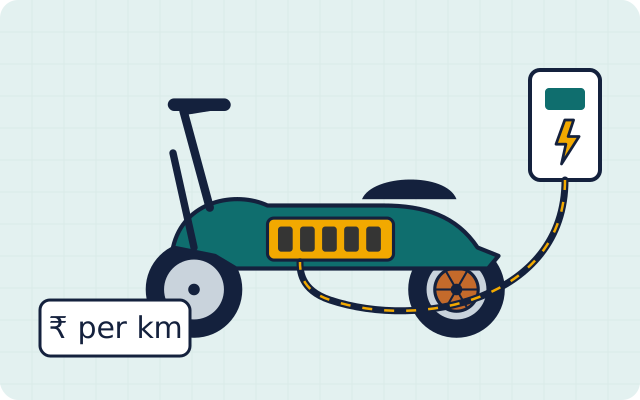
Plug a scooter into a 3D wall charger and watch its 16 cells fill. Change the charger current, the chemistry, the weather and the cooling, and see the charging time, the heat and the cost change.
Put a 2 kW motor on a 3D rig and tilt the ramp. Choose a hub motor or a mid motor with a belt, change the gear ratio, the wheel size and the load, and see pull, top speed and hill-climbing change.
Put in your own prices and daily running. See usable energy, weight, battery life, cost per km and five-year spend side by side, then the checks to make before switching.
Put in a car-size battery, its efficiency and your electricity price. See real-world range, how long AC or DC charging takes, the cost of a full charge, cost per km, and how much you save against petrol.
Everyone8 minutesFree, no sign-up
Starter experiments
Short experiments to see the basic ideas: how a cell charges, why packs need balancing, series and parallel, and how the motor turns.
Drag to turn the scooter. Tap a part to hear what it does.
Battery pack
The battery pack stores the energy. Many small cells are joined in series to raise the voltage and in parallel to raise the capacity.
Charging and discharging
While charging, lithium ions move from the cathode to the anode and are stored there. While riding, they travel back and the electrons flow through the motor. The state of charge shows how full the cell is.
State of charge
50%
Cell balancing
Cells in a pack drift apart over time. In passive balancing, the BMS drains a little energy from the fullest cells as heat until they match the others, so no cell is overcharged.
The pack can only charge until its fullest cell reaches 100%.
Build a battery pack
Cells in series add their voltages. Cells in parallel add their capacity. Energy in watt-hours is the pack voltage multiplied by its amp-hours.
48.1 VPack voltage
10 AhCapacity
481 WhEnergy
52Cells
–Rough range
How the motor turns
The controller switches current through three sets of coils one after another. This makes a magnetic field that turns in a circle, and the magnets in the rotor follow it.
Talk to Voltesta
Message us on WhatsApp in your own words. A message is ready for you to edit, and we reply within one working day.